Moxibustion at Home: How My Grandmother Warmed Her Knees Every Winter
Every winter evening after the dishes were done, my grandmother would sit on the sofa, light a moxa stick, and hold it over her knees. No ceremony, no explanation — just a quiet half-hour of warmth while she watched TV. She called it "warming the joints." We called it her winter habit.
The setup was almost absurdly simple. A moxa stick — a cigar-shaped roll of dried mugwort — bought from the herbal shop down the street for a few yuan a box. An old towel draped across her lap. The windows closed, so the smoke wouldn't scatter and the neighbors wouldn't joke that the house smelled like a temple. And her, sitting cross-legged on the sofa, the glowing tip of the moxa stick hovering an inch above her kneecap, its thin line of smoke curling upward through the lamplight.
She didn't look like someone doing a treatment. She looked like someone reading a magazine who happened to be holding a stick of burning herbs. That casualness, I think now, was the whole point. The habit had worn itself so deep into her evenings that it wasn't a decision anymore. It was just what happened after dinner, the way other people brushed their teeth or let the cat out.
How she did it
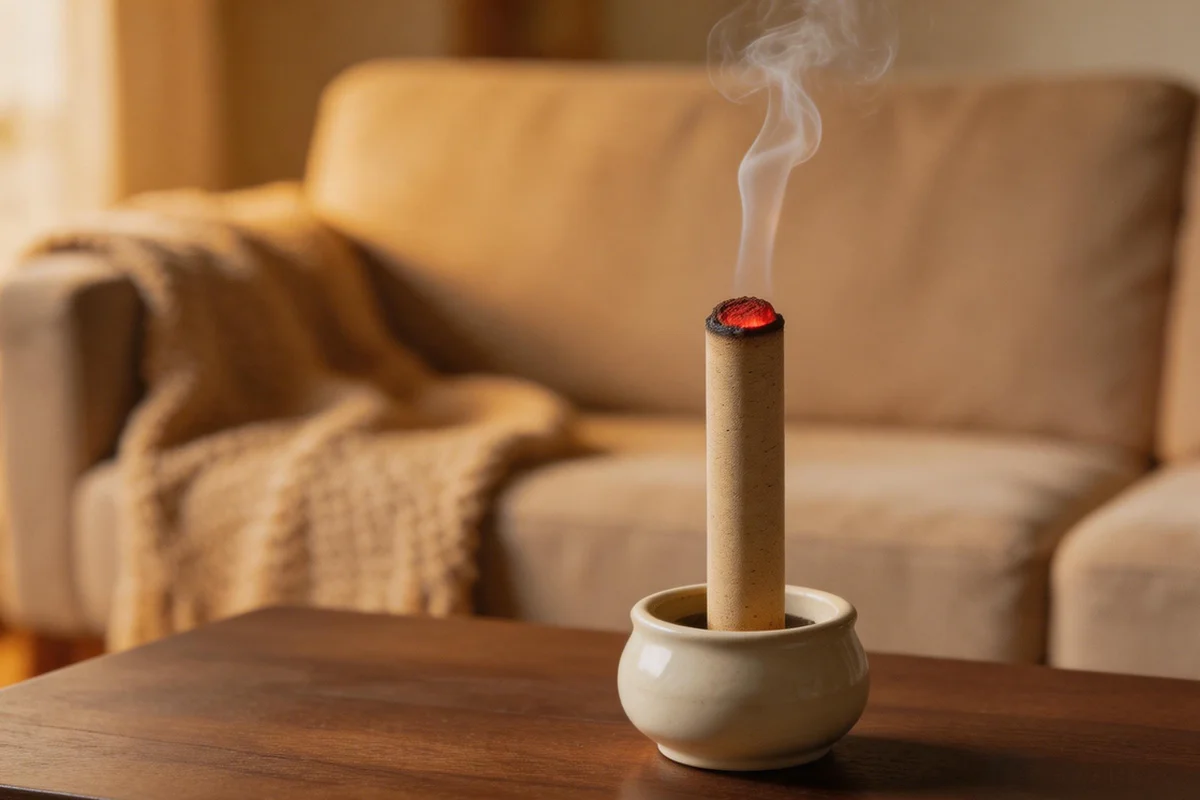
She'd light the moxa stick the same way she lit incense — with a match, never a lighter, because a match gave her more control over the tip. She'd blow on it until the tip glowed evenly, no flame, just a steady orange ember. Then she'd sit, settle the towel over her right knee, and hold the stick close enough to feel the heat but far enough not to burn. An inch, maybe a little more. She never measured. Her hand knew the distance after decades of practice.
One knee at a time. Ten, maybe fifteen minutes per side. When the right knee felt thoroughly warm — not hot, not uncomfortable, just deeply warm — she'd switch to the left. The spent ash would fall onto the towel, and she'd tap the moxa stick against the edge of an ashtray to knock off the excess before continuing. The whole thing took about half an hour, which was roughly the length of a single TV drama episode. Coincidence? I doubt it.
When she was done, the ritual had one more step: thick wool socks. "Can't let the warmth escape," she'd say, pulling them up over her knees if the socks were long enough, or simply wearing two pairs if they weren't. She'd press her palms against her kneecaps for a moment, as if checking that the heat had really settled in, and then she'd stand up and go about the rest of her evening — make tea, fold laundry, call my aunt on the phone — moving with the unhurried ease of someone whose joints were not complaining.
What she said about it
I asked her once, when I was old enough to be curious, why she did it. She looked at me the way she looked at questions whose answers seemed too obvious to state. "Knees warm, person comfortable," she said in Chinese — practically a shrug in sentence form. Then, after a pause: "You walk your whole life on these two things. You should take care of them."
She never used words like "therapy" or "moxibustion" or "traditional Chinese medicine." She called it "warming the knees." The mugwort stick was just "the smoke stick." The towel was "the old towel." The whole vocabulary of the practice was domestic and flat, deliberately undescriptive, as if giving things grand names would turn a simple comfort into something too serious to enjoy.
Where the habit comes from
Moxibustion — the practice of burning dried mugwort near the skin — goes back at least two thousand years in China. Early medical texts describe it as a method for "warming the channels" and "dispelling cold." In folk practice, these concepts translated into something simpler: if a part of your body is cold and stiff, warm it up gently and consistently, and it will feel better. The knee, as the joint that bends most often and bears the most weight, became one of the most common sites for this kind of home treatment.
Mugwort — ai ye (艾叶) in Chinese — is the same herb used in mugwort foot soaks and countless other folk remedies. It grows wild across much of China, dries easily, and burns slowly with a steady, mild heat. These practical qualities made it a household staple long before anyone wrote down what it was supposed to do. My grandmother didn't know about the classical texts. She knew that the herbal shop sold moxa sticks for cheap and that they felt good on her knees in winter. That was enough.
She sometimes paired the moxa with a coarse salt heat pack — her other winter weapon — alternating between the two depending on whether she wanted dry warmth (the salt bag) or the deeper, smokier heat of the moxa stick. The salt pack was for afternoons. The moxa was for evenings, when the day's walking had settled into her joints and needed to be coaxed back out.
What I observed
I'm not making any claims here. I'm just telling you what I saw: my grandmother, in her eighties, could still squat in the garden to pull weeds, walk to the market and back without stopping, and sit cross-legged on the floor to play with her grandchildren long after most of her neighbors had switched permanently to chairs. Was it the moxa? Was it genetics? Was it the fact that she moved more in a day than most people move in a week? I don't know. I'm writing down the habit, not defending a hypothesis.
What I do know is that she never missed an evening. If she was traveling, she packed moxa sticks in her suitcase. If she was sick in bed with a cold, she'd still sit up long enough to warm her knees before sleeping. The regularity of it impressed me more than any single session. She wasn't treating a problem. She was maintaining a baseline, the way you'd water a plant or oil a hinge. Preventative care, in its most mundane and most disciplined form.
Comfort and safety
Moxa sticks burn at high temperatures. The glowing tip can cause serious burns if it touches skin, and the ash can smolder and damage fabric or furniture. Always use a non-flammable surface underneath (a ceramic plate, a metal ashtray) and never leave a lit moxa stick unattended. Keep a small bowl of water nearby to extinguish the stick fully when you're done — don't just tap off the ash and assume it's out.
Ventilation matters. Moxa smoke is mild but can build up in a closed room. Open a window a crack, even in winter. The towel over the knee will catch most of the ash, but the smoke still needs somewhere to go. If you have asthma, respiratory sensitivity, or live with someone who does, this practice may not be suitable for you.
Pregnant women should avoid moxibustion entirely unless directed by a qualified practitioner — certain acupuncture points and moxa techniques are specifically contraindicated during pregnancy. People with reduced sensation in their skin (from diabetes, neuropathy, or other conditions) should not use moxa at all, since they may not feel a burn until it has already caused damage. The same goes for anyone with a skin condition, open wound, or recent surgery near the area.
This is a description of one person's folk habit. It is not a recommendation, not a prescription, not a substitute for anything a doctor tells you.