Morning Warm Water: The First Kitchen Ritual
Every morning, without exception, my grandmother would walk into the kitchen, fill the kettle, set it on the stove, and wait. Not for tea. Not for coffee. Just water. Warm water, poured into a small ceramic cup, sipped slowly while the rest of the house was still asleep. It was the first thing she did after washing her face. Before the rice congee. Before the vegetables. Before anything else. One cup of warm water, in silence, by the kitchen window.
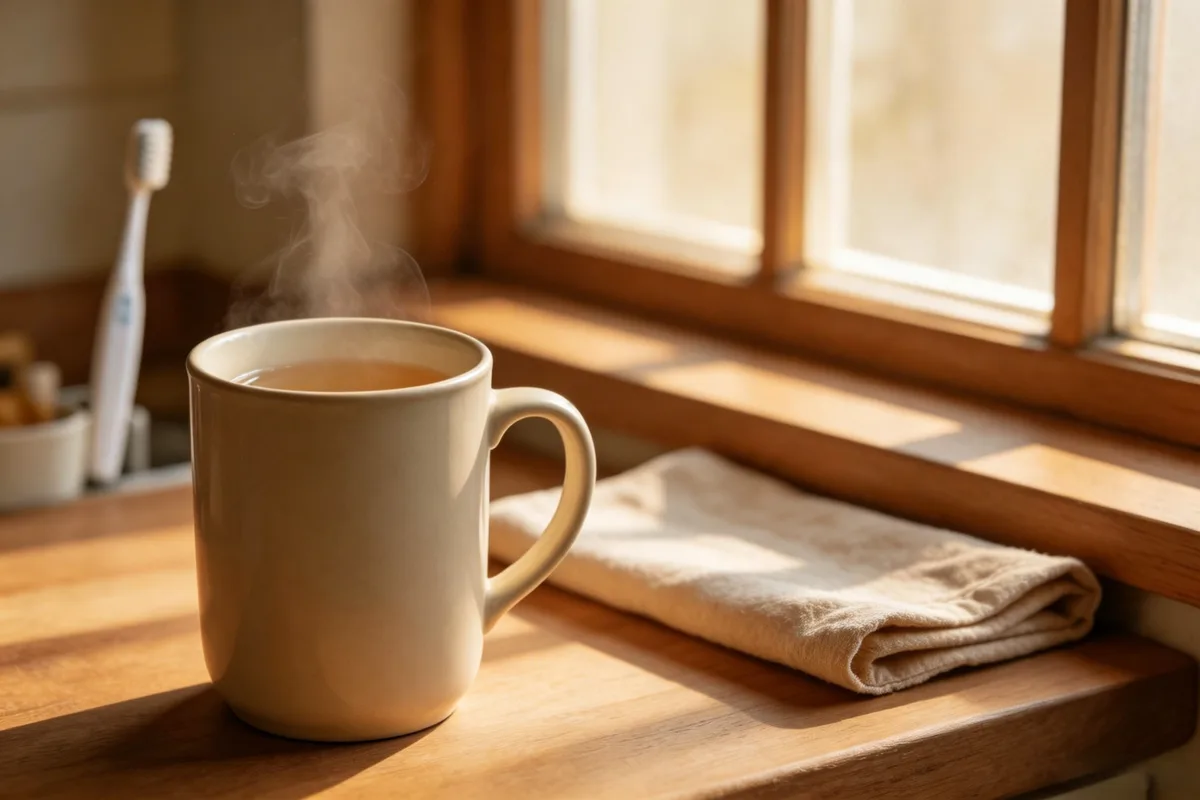
The kettle she used was the same kettle she'd owned for thirty years — dark aluminum, dented on one side from the time my grandfather knocked it off the counter. She'd fill it from the tap, set it over a low flame, and go about her morning washing while the water heated. She never let it boil. A proper boil would mean waiting another ten minutes for it to cool, and my grandmother was a patient woman about most things but not about her morning rhythm. When the first small bubbles appeared at the bottom of the kettle — what Chinese cooks call "crab eyes," the stage just before a full boil — she'd lift it off the flame. Pour. Wait. Sip.
The temperature mattered. Too hot and you couldn't drink it. Too cold and there was no comfort in it. She aimed for somewhere just above body temperature — warm enough to feel in your chest as it went down, cool enough to drink without blowing on it. If she handed you a cup and it was too hot, she'd click her tongue and take it back. "Rushing," she'd say, not looking at you. "Rushing ruins everything."
A habit I didn't understand until I left home
As a child, I found the whole ritual baffling. Warm water tastes like nothing. It's not sweet. It's not refreshing the way cold water is on a hot day. It doesn't have the ceremony of tea or the richness of broth. It's just water — slightly warm, faintly metallic from the old kettle, served in a plain cup with no decoration. Why would anyone choose this over the things that actually taste like something?
I asked her once, maybe when I was eleven or twelve. She looked at me the way she looked at questions that were too obvious to deserve answers. "Your stomach wakes up cold," she said. "You give it something warm so it knows the day has started." That was it. No lecture. No explanation of tradition. Just one sentence, delivered while she stared out the kitchen window at the grey Chengdu morning, the cup warm in both hands.
Years later, living in a different city, waking up to an empty kitchen with no kettle on the stove and no one pouring warm water into a ceramic cup, I started doing it myself. Not because I remembered her explanation — I'd forgotten it by then. But because the morning felt wrong without it. The kitchen was too quiet. The transition from bed to breakfast was too abrupt. I bought a kettle. I filled it. I waited for the crab eyes. And when I held that warm cup in my hands and looked out my own window at a different sky, I understood. The water wasn't the point. The pause was the point.
A habit shared across northern kitchens
Later I learned that my grandmother was not unique. In households across northern China — in Hebei, in Shanxi, in the colder provinces where winter mornings bite hard — the cup of warm water is about as common as brushing your teeth. Nobody writes about it. Nobody posts pictures of it. It's too ordinary to be worth mentioning. But if you ask, half the people you know will say their grandmother did the same thing. The other half will say they do it themselves and never thought about why.
A friend from Beijing told me her father called it "waking up the insides." A colleague from Tianjin said her mother insisted on warm water with a single red date dropped in — barely enough to tint the water, not enough to call it tea. The variations are endless and meaningless. The family tradition itself — the pause, the warmth, the quiet start — is what travels.
In Chinese kitchen language, there is a phrase that comes up again and again in old households: "morning care for the stomach" — zao shang yang wei (早上养胃). The word yang here doesn't translate neatly. It's not "treat" or "fix" or "heal." It's closer to "tend" — the way you tend a plant, or tend a fire, or tend to someone who needs quiet company. A morning cup of warm water, in that way of thinking, is not a remedy for anything. It's a greeting. The body has been asleep for eight hours. The water says: hello, we're awake now, let's begin.
How to carry the habit into your own kitchen
There is no recipe. That's the whole point. But if you want to try it, here is how my grandmother did it, and how I do it now:
- The water: Tap water, filtered if your tap water doesn't taste good. Heat it until the first small bubbles appear at the bottom — the "crab eye" stage. Do not let it reach a rolling boil. You want warmth, not steam.
- The cup: Something small. A ceramic cup, a glass jar, whatever fits in one hand. My grandmother used a plain white cup with a hairline crack she'd been ignoring for twenty years. Size matters more than material — about 200 milliliters, roughly the size of a small tea cup. Enough to feel, not enough to feel full.
- The timing: First thing. After washing your face, before eating anything. Before the phone. Before the news. Before the world gets loud.
- The pace: Slow. Standing or sitting by a window. No book. No screen. Just the cup and the morning and the quiet. Five minutes. Maybe ten.
That's it. That's the entire habit. It takes less time than scrolling through your phone and costs less than a single tea bag.
The cup on my windowsill
I still drink warm water in the mornings. I don't do it every day — I'm not as consistent as my grandmother was, and I doubt I ever will be. Some mornings I'm late. Some mornings I forget. But on the mornings I remember, when I fill the kettle and wait for the crab eyes and pour the water into the same kind of plain ceramic cup, I feel like the day starts on my terms instead of the world's.
It's been years since I watched my grandmother at her kitchen window. She's gone now. But the kettle is still on my stove, and the cup is still warm, and the quiet five minutes before the day begins still feel like the most honest part of the morning. Not because the water does anything special. Because someone I loved did this every day, and now I do it too, and that's how a habit becomes a home.