Goji Berry Tea: The Cup My Grandmother Poured for Tired Eyes
Every afternoon around three, my grandmother would stop whatever she was doing, reach for the tin canister on the second shelf, drop a small handful of dried red berries into a glass jar of hot water, and sit by the window. She never said "this is for my eyes." She just did it, the way you'd stretch your shoulders or roll your neck — a small ritual attached to a small complaint, repeated for decades.
The berries lived in that same tin canister for as long as I can remember. Next to the dried dates and the rock sugar. Dried goji berries — gou qi (枸杞) in Chinese — look like tiny red raisins, slightly shriveled, faintly sweet, softer than you expect. We never ran out. When the canister got low, someone refilled it from the bulk bin at the market. It was that kind of household staple — not precious, not expensive, just always there.
My grandmother's relationship with this tea was entirely practical. She sewed for hours — mending, altering, making clothes for half the neighborhood — and by mid-afternoon her eyes would be tired. She never complained. She just made her tea. A handful of berries from the tin canister, hot water from the thermos, and twenty minutes of sitting still while the berries steeped and the afternoon light softened through the window.
Where the habit comes from
Goji berries have been a kitchen ingredient in China for longer than anyone can trace. Not a supplement — a food. They show up in soups, in congee, in stir-fries, and very often in a simple cup of hot water. Chinese folk kitchen language describes them as "brightening" — a word that in daily conversation means something closer to "refreshing" than anything clinical. The kind of brightening you feel after splashing cold water on your face, not after taking a pill.
In traditional Chinese dietary culture, goji berries are often paired with chrysanthemum flowers for a slightly more floral version, or with red dates for sweetness. But the simplest version — just berries and hot water — is what most households actually reach for, because it's what's in the cupboard, because nobody has time to measure, because the habit was never about precision.
Some evenings my grandmother would switch to sour jujube seed tea when her mind was busy and sleep didn't come. But the afternoon cup was always goji — quiet, warm, and finished before the light changed.
How my grandmother made it
She didn't have a method. She had a rhythm. Fill a glass jar — always glass, so you could see the color bloom — with hot water from the thermos that lived on the kitchen counter. Open the tin canister on the second shelf. A small handful of berries, maybe fifteen or twenty, dropped into the water. Let them sit while you do something else — finish a seam, read a few pages, stare out the window. When the water turns pale orange-pink, it's ready. Sip. Refill. The second steep is always lighter, which she liked better anyway.
She'd eat the swollen berries at the bottom when the tea was done — soft and warm, like tiny pieces of stewed fruit. "Don't waste," she'd say if she caught me looking. That was the extent of her instruction.
What it looks like in daily life
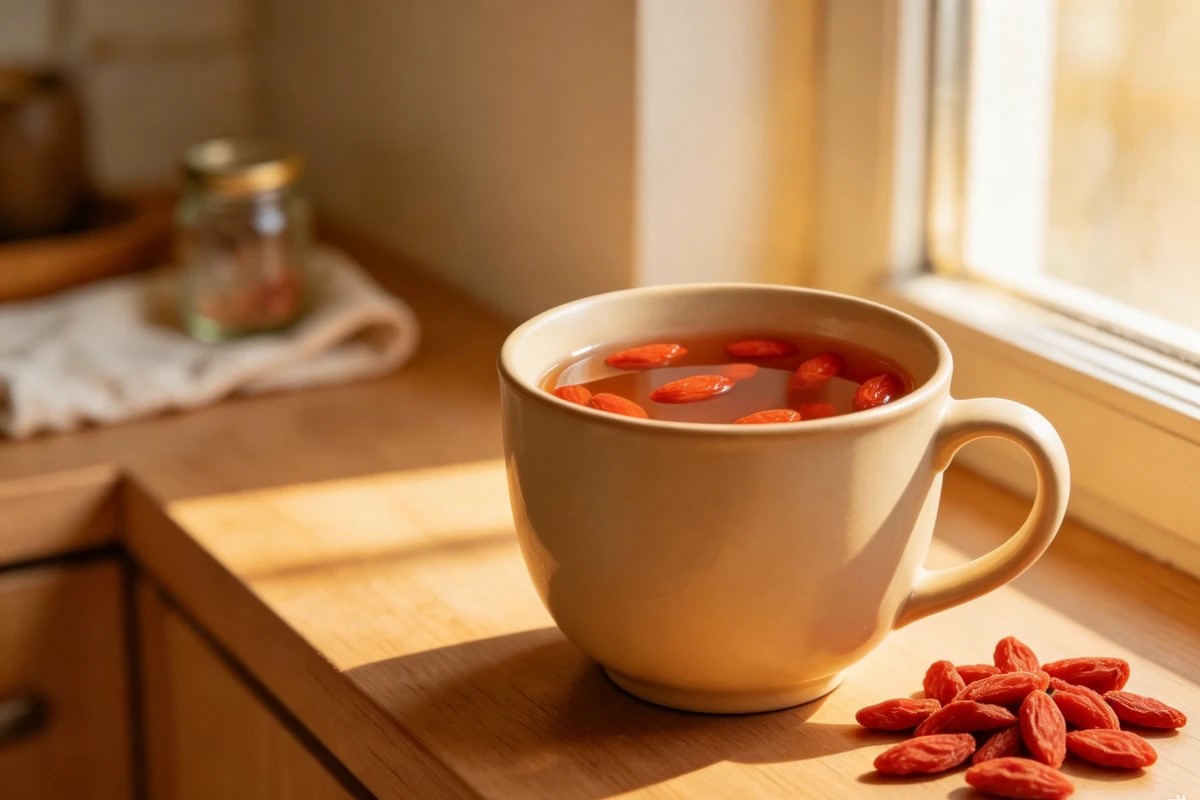
The habit is deeply ordinary. My grandmother never called it "goji berry tea" — it was just "berries in water," a phrase so plain it barely counted as naming. She drank it year-round, though in winter she might steep the berries a little longer, holding the warm glass in both hands for the heat as much as the taste.
In our household, it was just berries — the plain version, the lazy version, the version you make when explaining what you're doing would take longer than doing it.
Comfort and safety
Goji berries are a food. But some people have reported interactions between goji and warfarin (a blood thinner), so if you're on that medication, skip this one or ask your doctor. Very hot water can burn. Let it cool. If you don't like the taste, don't finish it. This is a cup of tea, not an obligation.
The Shennong Ben Cao Jing mentions goji berries as a common food ingredient, noting their widespread use across Chinese kitchens for centuries. I include the reference not as endorsement but as context: people have been drinking this tea for a very long time.
Referenced from Shennong Ben Cao Jing (Divine Farmer's Materia Medica)Regional variations
Ningxia province in northwestern China is famous for goji berries — the dry climate produces berries that are larger and sweeter. In southern China, people add fresh ginger slices during damp months. In Shanghai, some households blend goji with chrysanthemum for a floral afternoon drink.
If you're outside China, dried goji berries are available at most Asian groceries and online. Look for berries that are deep red with a slight shine. Store them in a sealed tin or jar away from direct light, the way my grandmother did, and they'll keep for months.