Ginger Foot Soak for Cold Feet Comfort: What My Grandmother Did Before Bed
If my grandmother couldn't sleep because her feet were cold — and in a Chengdu winter, with the damp climbing up through the floorboards, this happened often — she didn't count sheep. She got up, walked into the kitchen, sliced a knuckle of old ginger into a basin, and filled it with hot water. Twenty minutes later she'd be asleep. "Warm feet, good sleep," she'd say the next morning, as if that were the most obvious equation in the world.
I grew up in a household where foot-soaking was not a luxury. It was closer to a life skill — the domestic equivalent of knowing how to make rice or fold a blanket. Everyone in the family had their own version. My father liked plain hot water, the hotter the better. My mother added a handful of salt. But my grandmother's version — fresh ginger slices floating in a wooden basin — was the one that stuck with me, partly because she did it so consistently and partly because she was the only one who never complained about the cold.
How she did it
She kept a separate piece of ginger in the kitchen — older, drier, more fibrous — specifically for foot soaks. The fresh, plump ginger was for cooking. The old, wrinkled root was for the basin. She never explained this categorization system; she just maintained it, the way some people keep a separate sponge for dishes and another for counters. When I asked her once whether it mattered which ginger you used, she said "old ginger is stronger," and that was the end of the explanation.
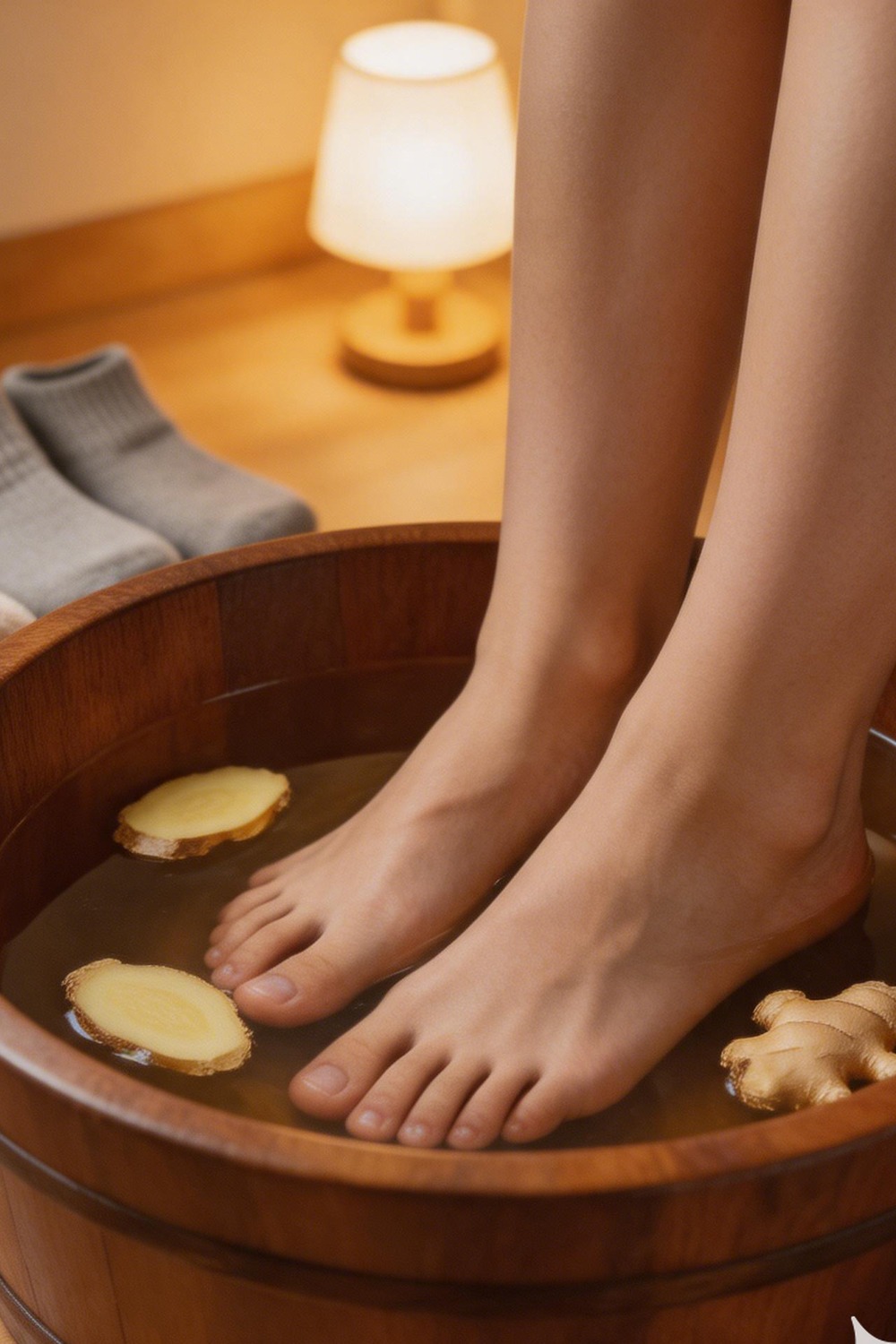
She'd slice it thick — half a centimeter, maybe more — and never peel it. "The skin has its own job," she'd say, though she never specified what the job was. Into a wide wooden basin the slices went, followed by hot water from the kettle. Not boiling. She tested the temperature with the back of her hand — never the palm, because the palm could handle more heat than the foot could, and she didn't trust it to give an honest reading.
The water had to come up past the ankles. If it didn't cover the ankle bones, she'd add more. Then she'd sit — on the edge of the sofa, a towel across her lap, her feet submerged — and do nothing. No phone, no book, no TV. Just twenty minutes of sitting while the ginger-scented water did whatever it was doing. This was, I think, the hardest part of the habit to understand when I was young: the deliberate stillness. She wasn't soaking her feet because she was tired. She was soaking her feet, and also she was being still, and the two things reinforced each other.
When her feet turned pink — a deep, healthy pink, the color of good circulation — she'd pull them out, dry them with the towel, and immediately put on a pair of thick cotton socks. "Don't let the heat run away," she'd say. Then she'd go straight to bed. No detours, no late-night snacks, no last-minute chores. The warm feet were a one-way ticket to sleep, and she wasn't going to waste them standing around in a cold kitchen.
What she said about it
My grandmother was not a woman of elaborate health philosophies. She had sayings instead — short, practical, repeated so often they became household wallpaper. About this habit, she had exactly one: "Warm feet, good sleep." The Chinese version — "脚暖了,觉就好睡了" — has a rhythm that doesn't quite translate, a kind of folk certainty that makes the causal connection sound as natural as "water wet, fire hot."
She never claimed the ginger did anything specific. She never mentioned circulation or inflammation or any of the biological terms that have since been retroactively attached to this practice by wellness blogs. The ginger was there because her mother had used ginger, and her mother's mother before that. It was an ingredient in the habit, not the subject of a theory. You put ginger in the water because that's what you did, the same way you put salt in soup.
On nights when her feet were especially cold, she'd sometimes drink a cup of fresh ginger tea while she soaked — ginger inside and ginger outside, a full ginger offensive. And on other nights, when she wanted something different, she'd switch to dried mugwort instead, the same herbs she used for her evening foot soaks in warmer months. The two habits sat comfortably next to each other in her routine, not competing, just alternating according to mood and season and whatever was in the cupboard.
Why this makes intuitive sense
Forget Chinese medicine for a moment. Forget folk theories about "warming the channels." Think about it purely as a person with cold feet: warm water makes cold feet warm. Warm feet help you fall asleep. Ginger makes the warm water smell pleasant and feel slightly tingly on the skin, which is a sensation that some people find relaxing. Whether the ginger is doing anything physiological or just giving the moment a pleasant sensory texture — the smell, the faint warmth, the feeling of doing something deliberate for yourself — the outcome is the same: you get into bed with warm feet, and warm feet make it easier to fall asleep.
I've tried this myself enough times to know it works for me, in the limited sense that I sleep better after a hot foot soak than I do without one. Is the ginger necessary? Probably not. But it makes the water smell nicer, and the ritual feels more intentional than just plain hot water, and sometimes the feeling of doing something is as important as what the thing actually does. Placebo gets a bad name. In my experience, a good placebo is worth keeping.
Comfort and safety
Water that feels pleasantly warm to your hand can still scald your feet if you're not paying attention, especially for older adults, people with diabetes, or anyone with reduced sensation in their feet. Test with the back of your hand the way my grandmother did. If you can't comfortably hold your hand in the water for ten seconds, it's too hot. Start cooler than you think you need, and add hot water gradually if you want more heat.
People with diabetes, peripheral neuropathy, peripheral vascular disease, or any condition that affects sensation or circulation in the feet should consult a healthcare provider before soaking. The same goes for anyone with open cuts, blisters, fungal infections, or skin conditions on their feet — warm water can worsen some of these. Pregnant women should keep water temperature moderate (not hot) and check with their doctor if unsure.
Don't soak for more than twenty minutes. Don't use water so hot that your skin stays red for more than a few minutes after you dry off. Don't add essential oils, salts, or other substances unless you know how your skin reacts to them. And if your feet stay cold no matter what you do — especially if one foot is consistently colder than the other — that's worth mentioning to a doctor. Cold feet can be a circulation issue, not just a weather issue.